
Three vendors. Three purchase orders. Three quality systems. Three schedules to track, three invoices to reconcile, and three phone calls to make when something goes wrong.
That is the daily reality for procurement teams managing multi-vendor assemblies across automotive, appliance, and industrial manufacturing. Every handoff between suppliers introduces a place where cost hides, quality slips, and lead time stretches. The math looks fine on a line item comparison. It stops looking fine once you add up the freight, the coordination overhead, the rework from process mismatches, and the engineering time spent chasing problems across three separate organizations.
This guide explains the benefits of single source manufacturing, why the model is gaining traction among OEM procurement teams, and how to evaluate whether consolidation makes sense for your programs. By the end, you will know what to measure, what to ask, and where to look for the cost that a multi-vendor model buries.
Why Vendor Count Matters More Than Piece Price
The standard procurement approach starts with piece price. Send specs to five suppliers, compare the per-unit number, and award the lowest bid. That comparison captures one cost. It misses everything else.
When a single assembly is split across multiple suppliers, each handoff creates a layer of cost that rarely shows up on the quote sheet. According to the American Society for Quality, quality-related costs consume 15 to 20 percent of sales revenue for most manufacturers. A meaningful share of that cost traces back to variation introduced at process transitions, where one supplier finishes and another begins.
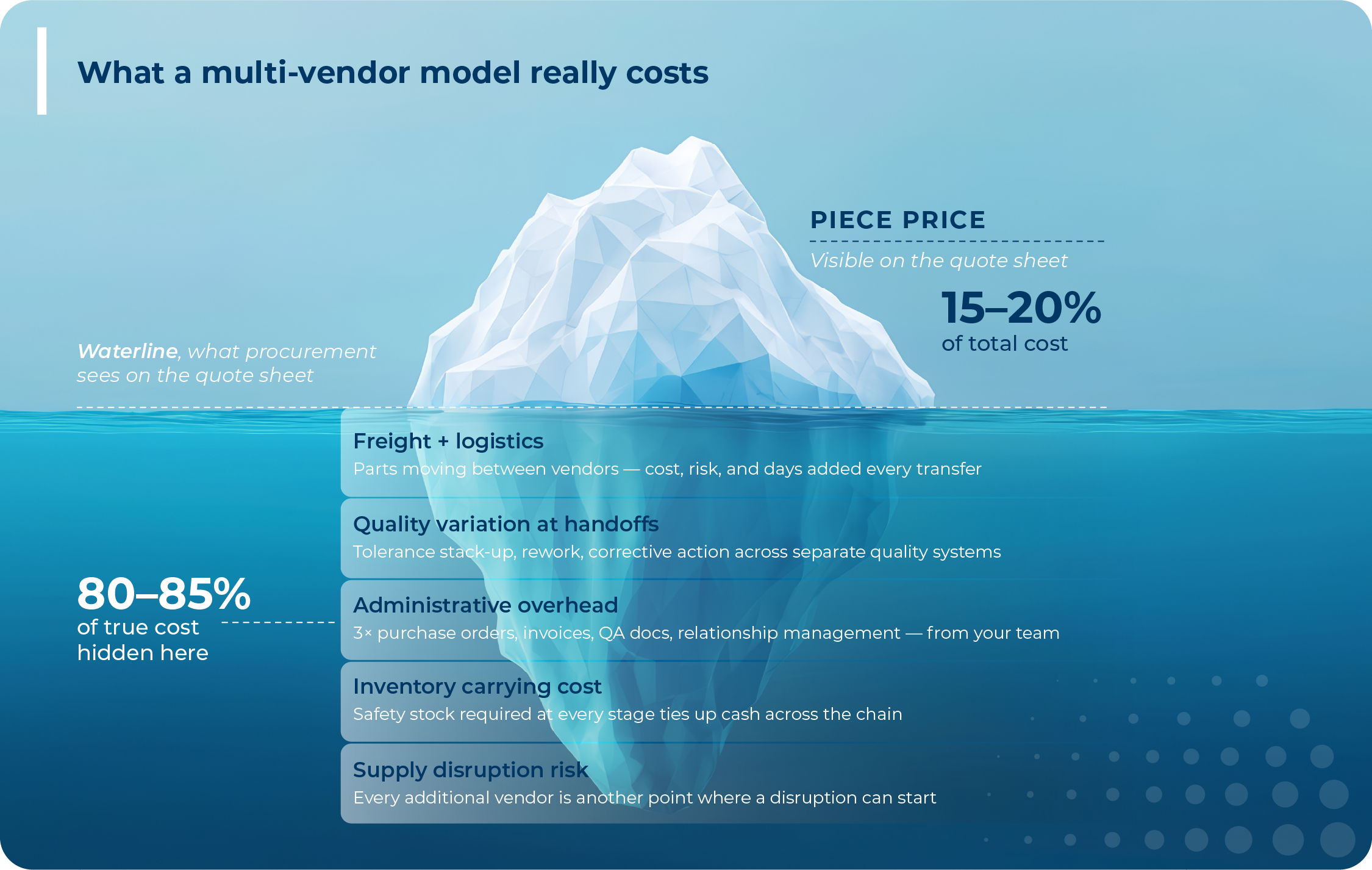
Hidden costs in a multi-vendor model include:
- Freight and logistics. Parts moving between vendors accumulate shipping cost, handling risk, and time. Every transfer adds days to the schedule.
- Quality variation at handoff points. Different suppliers use different measurement methods, sampling plans, and datum references. Variation that hides inside individual vendor tolerances can stack up into a defect you only see at final assembly.
- Administrative overhead. Each additional vendor requires its own purchase orders, invoices, quality documentation, corrective action tracking, and relationship management. That coordination time comes from your team, not from the suppliers.
- Inventory buffering. Longer, more complex supply chains require more safety stock at every stage to protect against delays. That inventory ties up cash.
- Root cause complexity. When a defect surfaces in a multi-vendor assembly, tracing the source requires investigation across organizations with separate data systems and separate quality records. The longer root cause takes, the longer the problem runs.
A single source manufacturing partner eliminates the handoffs. Material conversion, fabrication, assembly, and finishing happen in one facility, under one quality system, tracked against one set of process controls. When you reduce vendor count in manufacturing, the cost that was hiding in the spaces between vendors disappears, because the spaces disappear.
The Quality Argument: Fewer Handoffs, Fewer Defects
Quality problems in multi-vendor assemblies rarely start with a bad supplier. They start at the handoff.
Each time a partially completed component moves from one vendor to the next, it enters a new quality environment with different inspection criteria, different measurement equipment, and different process assumptions. A dimension that passes incoming inspection at Vendor B may have been measured differently at Vendor A. A material that performs well through one conversion process may behave differently through the next if the two vendors optimized for different parameters.
When those components arrive at final assembly and something does not fit, the investigation crosses organizational boundaries. Quality engineers at your facility contact Vendor A. Vendor A points to Vendor B. Vendor B says the incoming material was in spec. The corrective action stalls while three separate teams argue about whose measurement is right.
In a single source model, the same team that converts the material also molds it, trims it, assembles it, and inspects it. Process data flows from one step to the next without translation. If a problem surfaces, the quality engineer who finds it can walk to the station that caused it. Root cause analysis that takes weeks in a multi-vendor model takes days or hours when the entire process sits under one roof.
For automotive programs where defect traceability and corrective action speed directly affect your OEM scorecard, that compression matters.
The Speed Argument: Consolidated Lead Times
Lead time in a multi-vendor supply chain is not the sum of each vendor’s production time. It is the sum of their production time plus the transit time between them, plus the scheduling buffer each vendor builds in to protect their own capacity, plus the queue time at each receiving dock.
A part that takes three days to convert, two days to mold, and one day to assemble does not take six days. It takes six days of production plus the scheduling gaps, freight moves, incoming inspections, and queue times between each step. In practice, a six-day process can stretch to four or five weeks.
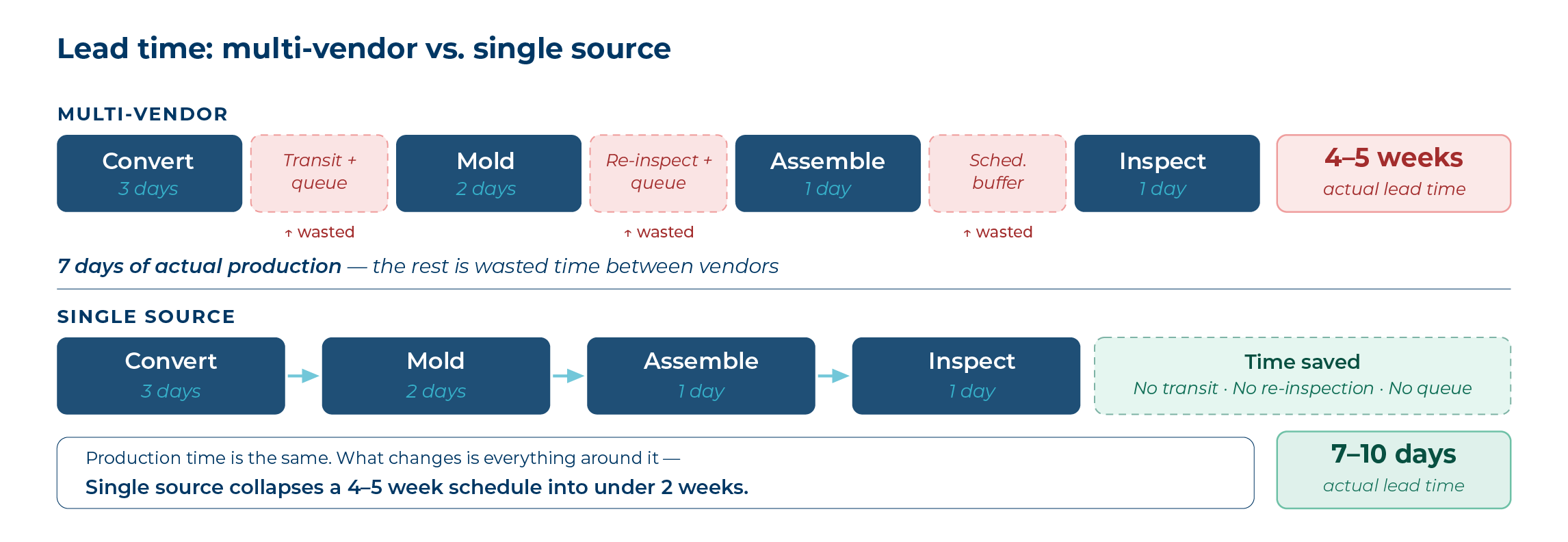
Single source manufacturing collapses that timeline. When conversion, molding, and assembly happen in one facility, parts move from one process to the next without shipping, without re-inspection at a receiving dock, and without sitting in a queue waiting for a different supplier’s production schedule to open up. The result is shorter, more predictable lead times that give your planning team real dates instead of stacked estimates.
For programs running on compressed launch timelines, that consolidation is not a minor efficiency. It is the difference between hitting the production date and pushing it.
The Cost Argument: Total Cost of Ownership
Piece price is one number. Total cost of ownership is the number that determines whether a sourcing decision actually saves money.
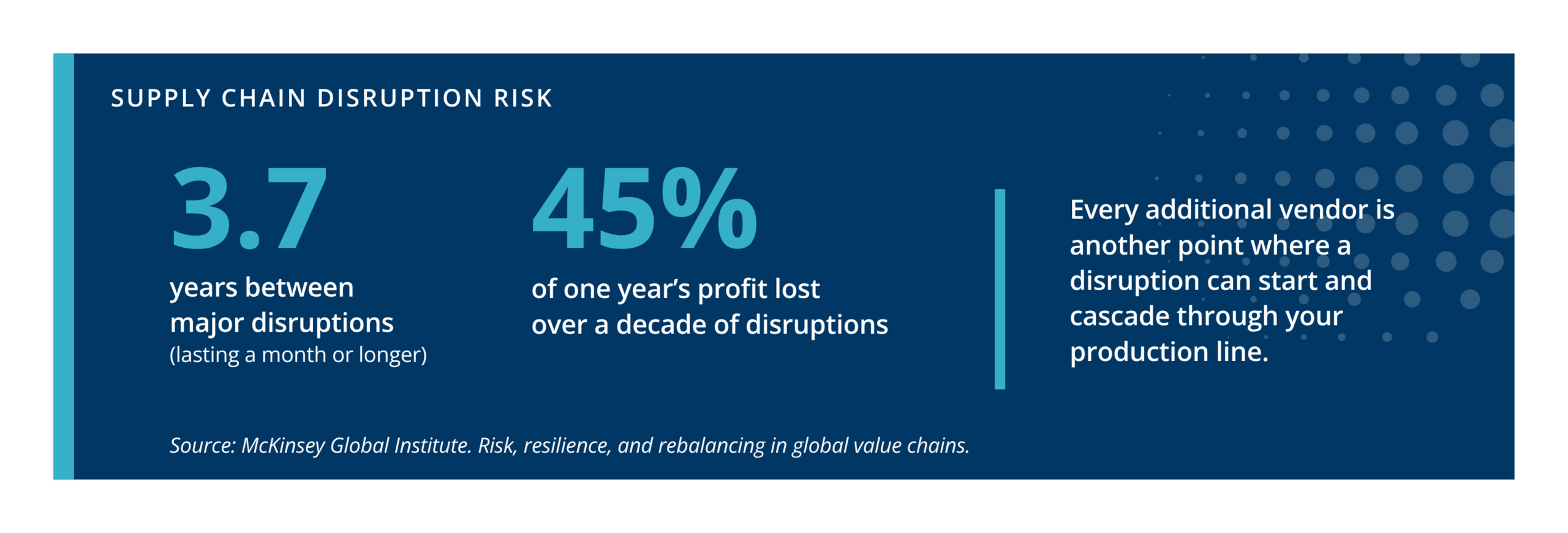
Research from the McKinsey Global Institute found that supply chain disruptions lasting a month or longer now occur every 3.7 years on average, costing the average organization 45 percent of one year’s profits over the course of a decade. Every additional vendor in a supply chain is another point where a disruption can start. Every handoff is another place where transit delays, quality holds, and communication failures accumulate cost that the original quote never captured.
A total cost of ownership comparison between a multi-vendor model and a single source model should account for:
- Piece price per unit at each vendor.
- Tooling and setup across all vendors.
- Freight between vendors and from the final vendor to your facility.
- Inventory carrying cost at every stage of the chain, including safety stock buffers.
- Quality cost including inspection, rework, scrap, and corrective action labor.
- Administrative cost including purchase orders, invoicing, vendor management, and engineering coordination.
- Disruption risk cost modeled as the probability and financial impact of a supply interruption at any node.
When procurement teams run this comparison honestly, the single source model often wins even when its piece price is not the lowest number on the page. The cost that used to hide between vendors shows up as savings when the spaces close.
The Resilience Argument: Supply Chain Stability
A supply chain is only as strong as its weakest link. In a multi-vendor chain, you have more links, and you have less visibility into the health of each one.
When one of your three vendors runs into a capacity problem, a material shortage, or a quality escape, the impact cascades through the chain. The other two vendors cannot ship their portions of the assembly until the third catches up. Your production line waits. Your customer’s production line waits.
Single source manufacturing reduces your exposure. One supplier relationship to manage means one set of capacity conversations, one inventory strategy to align on, one escalation path when something goes wrong. A manufacturer with deep material relationships and a stable, experienced workforce can often absorb disruptions that would stall a less established operation.
In the automotive supply chain, where OEMs commonly require annual cost reductions of 2 to 5 percent from their supplier base, a single source OEM supplier who can deliver those savings through process efficiency rather than margin pressure is a structurally stronger long-term relationship than a fragmented vendor network where each supplier protects their own margin independently. Supply chain simplification is not just an OEM procurement preference. It is an operating strategy that compounds over time.
When Single Source Makes Sense
Single source manufacturing is not the right answer for every component. It is strongest when the following conditions are present:
- Multi-process components. The part requires more than one manufacturing process, such as conversion, molding, and assembly. Each additional process adds a handoff in a multi-vendor model.
- Tight quality requirements. The component has tight tolerances, traceability requirements, or defect sensitivity where variation between vendors creates risk.
- Compressed timelines. The program is on a launch timeline that cannot absorb the scheduling gaps of a multi-vendor chain.
- Cost pressure. The program needs year-over-year cost reductions that are easier to achieve through process consolidation than through vendor-by-vendor negotiation.
- Supply chain simplification goals. Your organization is actively working to reduce vendor count in manufacturing to lower administrative burden and improve supply chain visibility.
Commodity parts with simple geometries, single-process manufacturing, and high availability from multiple sources may not benefit from consolidation. The case for single source manufacturing gets stronger as part complexity, process count, and quality sensitivity increase.
How to Evaluate a Single Source Manufacturing Partner
Moving from a multi-vendor model to a single source model is a sourcing decision that deserves a structured evaluation, not a leap of faith. The questions below help procurement teams distinguish between a supplier who claims to do it all and a manufacturer who actually controls the full process under one roof.
What to confirm before awarding a consolidated program:
- Process breadth under one roof. Verify that the manufacturer actually performs each required process in house. Subcontracting key steps back out defeats the purpose.
- Equipment capacity at your volume. Confirm capacity for your program at production volume, not theoretical maximum. Ask for utilization rates on the equipment your parts will run on.
- Material sourcing depth. Understand the supplier’s material relationships. A manufacturer with long standing purchasing relationships and preferred converter status can access material during shortages that newer entrants cannot.
- Quality system maturity. Look for ISO 9001 certification at a minimum, with SPC implementation, Cpk data on comparable parts, and a corrective action process that resolves issues in days, not months.
- Workforce stability. Average employee tenure is a leading indicator of process consistency. A workforce that stays builds institutional knowledge that shows up in your parts.
- References from current OEM accounts. Ask to speak with two to three existing customers who run similar programs. Their experience is the most reliable predictor of yours.
A practical evaluation sequence:
- Capability screening: Confirm that the manufacturer runs all required processes in house, holds relevant certifications, and has capacity in your volume range.
- RFQ with full technical package: Evaluate the quality of the quote, the questions the supplier asks, and the timeline they commit to.
- Site visit: Walk the floor. Verify equipment, process controls, workforce, and the actual flow a part takes from material receipt to finished shipment.
- Reference check: Speak with current OEM customers directly.
- Pilot run: Run a limited production sample with full quality documentation and review the results before committing to production tooling.
- Program award with review checkpoint: Begin with defined success metrics and a 90 day review to confirm performance under real conditions.
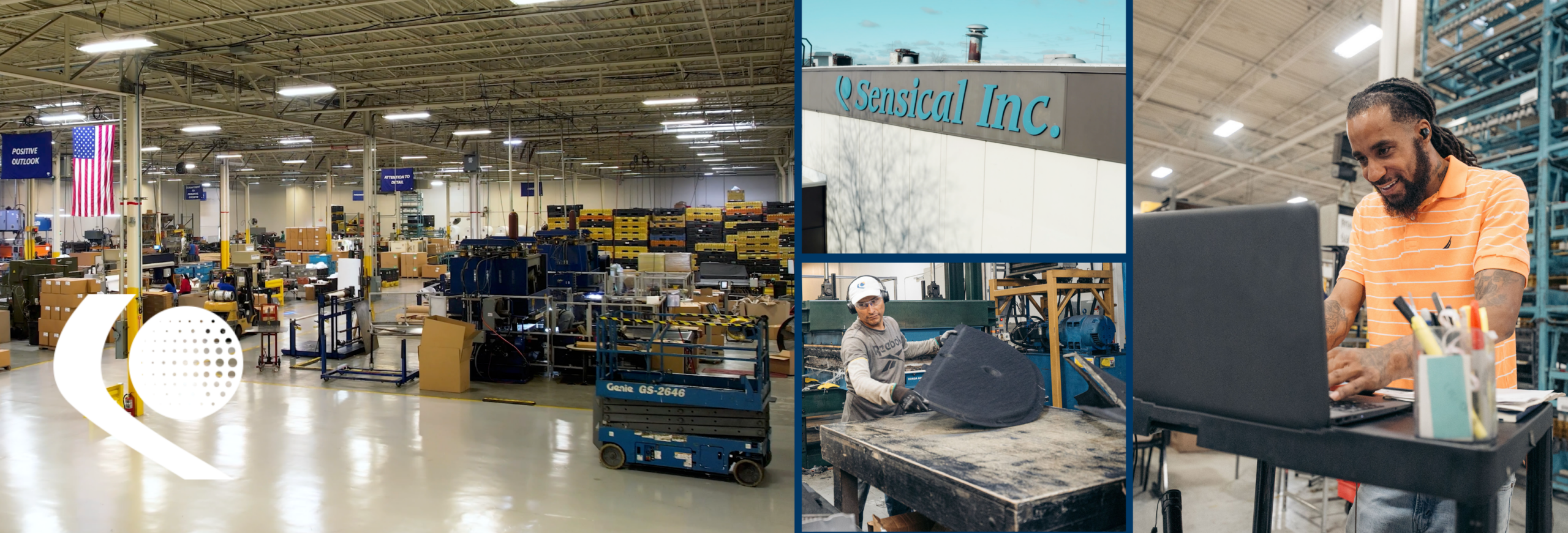
Sensical operates this model from its facility in Solon, Ohio. Material conversion and die cutting, compression molding, waterjet cutting, heat sealing, sub-assembly, and finishing all happen under one roof, under one ISO 9001:2015 certified quality system. The facility runs over 90 million components per year for more than 180 customers, with an average employee tenure exceeding 14 years. The kind of stability that shows up in the consistency of your parts.
Conclusion
The benefits of single source manufacturing are not theoretical. They are measurable in shorter lead times, lower total cost, fewer quality escapes, and simpler supply chain management. The model works best for multi-process components where handoff complexity, quality risk, and timeline pressure make vendor consolidation a strategic advantage rather than just a purchasing preference.
The decision is not about finding a single source manufacturing partner who does everything. It is about finding one who controls the processes your program needs, runs them well under one quality system, and takes ownership of the result from raw material to finished part.
If you are evaluating whether to consolidate your supply base for an upcoming program or an existing one that is not performing, start with a capability conversation. The right partner will ask as many questions as you do.
Frequently Asked Questions
What is single source manufacturing?
Single source manufacturing is a supply chain model in which one manufacturer handles multiple production processes for a component or assembly under one roof. Instead of splitting work across separate vendors for conversion, molding, assembly, and finishing, the entire production sequence stays with one partner. The goal is to reduce handoffs, shorten lead times, and simplify quality accountability.
What are the benefits of single source manufacturing for OEMs?
The primary benefits are lower total cost of ownership, shorter and more predictable lead times, fewer quality defects from process handoffs, simplified supply chain management, and a single point of accountability for the finished part. These benefits are strongest for multi-process components with tight quality requirements.
Is single source manufacturing risky because of supplier concentration?
Concentration risk is a valid consideration and should be part of any sourcing decision. The risk is managed through rigorous supplier evaluation, including site visits, quality system audits, capacity verification, and reference checks. A single source partner with deep material relationships, a stable workforce, and a proven track record across multiple OEM programs often presents less practical risk than a fragmented vendor chain where each link has less visibility and less accountability.
How do I evaluate whether single source manufacturing is right for my program?
Start by mapping the current supply chain for the component: how many vendors are involved, how many handoffs occur, and where quality and scheduling problems have surfaced. If the assembly requires multiple manufacturing processes and the handoffs are generating cost, quality, or lead time issues, consolidation is worth evaluating. Run a total cost of ownership comparison that includes freight, inventory, quality costs, and administrative overhead alongside piece price.
Does Sensical offer single source manufacturing in Ohio?
Yes. Sensical runs die cutting and material conversion, compression molding and vacuum forming, waterjet cutting, heat sealing, sub-assembly, slitting, laminating, and finishing from one facility in Solon, Ohio. The operation is ISO 9001:2015 certified and serves OEMs across automotive, appliance, and industrial markets.