
Picture a dash insulator that hits every acoustic target in the lab, then adds enough weight to push the program over its mass budget. Or a quote for injection tooling that never pays back at the volume you actually run. Or a large, contoured panel that no supplier wants to tool because the geometry fights the process.
Here is the thing. The process behind a huge share of automotive acoustic and thermal parts is one most buyers never think about, right up until a part fails to perform or comes in over weight. That process is compression molding.
This guide explains what compression molding is, how it works, how it compares to injection molding, and why it matters more now than it did five years ago. By the end, you will know which parts belong in a compression mold, what to ask a molder, and how to keep weight, cost, and noise targets from fighting each other.
Compression molding is a forming process that uses heat and pressure to shape a measured charge of material, such as a fiber mat, thermoset compound, or foam, inside a heated mold. In automotive manufacturing, it produces large, lightweight components, most often the acoustic and thermal insulators that control noise and heat inside a vehicle.
How Compression Molding Works
The process is straightforward, which is part of its appeal. A measured amount of material, called a charge, goes into an open, heated mold. The mold closes. Heat and pressure force the material to flow into every contour of the cavity, and it holds that shape as it sets. With thermoset materials, the heat triggers a curing reaction that locks in strength and dimensional stability. Fiber mats and thermoplastic compounds form to the tool the same way.
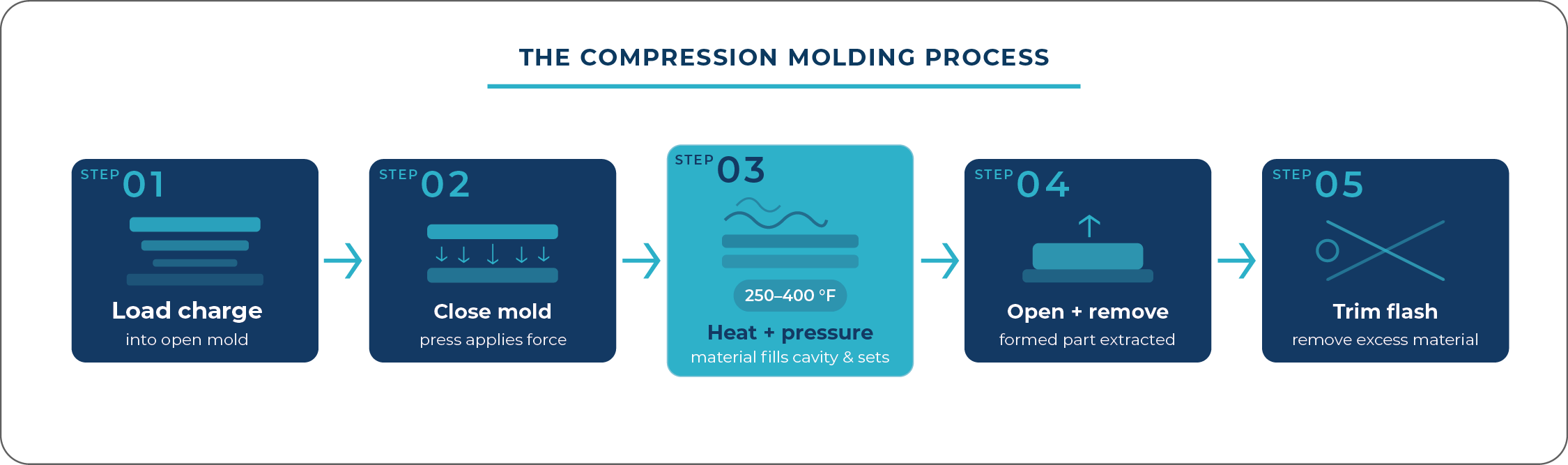
The basic sequence looks like this:
- Load a measured charge of material into the open, heated mold.
- Close the mold so the press can apply force.
- Apply heat and pressure until the material fills the cavity and sets. Metal molds typically run between 250 and 400 degrees Fahrenheit.
- Open the mold and remove the formed part.
- Trim any excess material, called flash, from the edges.
Two things matter here for a buyer. Compression molding wastes very little material, which protects your cost when the substrate is expensive. And it shapes parts close to their final form, so you spend less on secondary trimming and finishing. For high heat acoustical parts, a well designed tool can produce a finished shape with no post trim or waterjet step at all.
The Materials Compression Molding Shapes
Compression molding is not picky, but it has clear strengths. It excels with fiber reinforced mats, foams, and thermoset compounds, and it handles the large or thick walled geometries that frustrate other processes.
Common automotive substrates include:
- Fiberglass and glass fiber mat, used in structural and heat resistant parts
- PUR (polyurethane) foam, used for cushioning, sealing, and acoustic absorption
- PET nonwoven fiber, a workhorse for sound absorbing insulators
- Cotton shoddy and blended fiber mats, molded to hold a contour
Sensical molds substrates including fiberglass, PUR foam, and PET fibers through its compression molding and vacuum forming process, and does it with less waste than other molding methods. That material set is not an accident. It maps directly to the acoustic and thermal parts vehicles need most.
Compression Molding vs. Injection Molding
Buyers often weigh these two processes against each other, so it helps to be clear about where each one wins. Injection molding forces molten thermoplastic into a closed mold at high pressure. It runs fast, automates well, and produces complex, tight tolerance parts at high volume. The tradeoff is expensive tooling that only pays back across a large run.
Compression molding presses a charge in an open heated mold. The tooling is simpler and less expensive, the cycle takes longer, and the process favors large panels, fiber based materials, and lower to medium volumes. Injection molding is also poorly suited to large, thin parts like vehicle panels, which is exactly where compression molding does its best work.
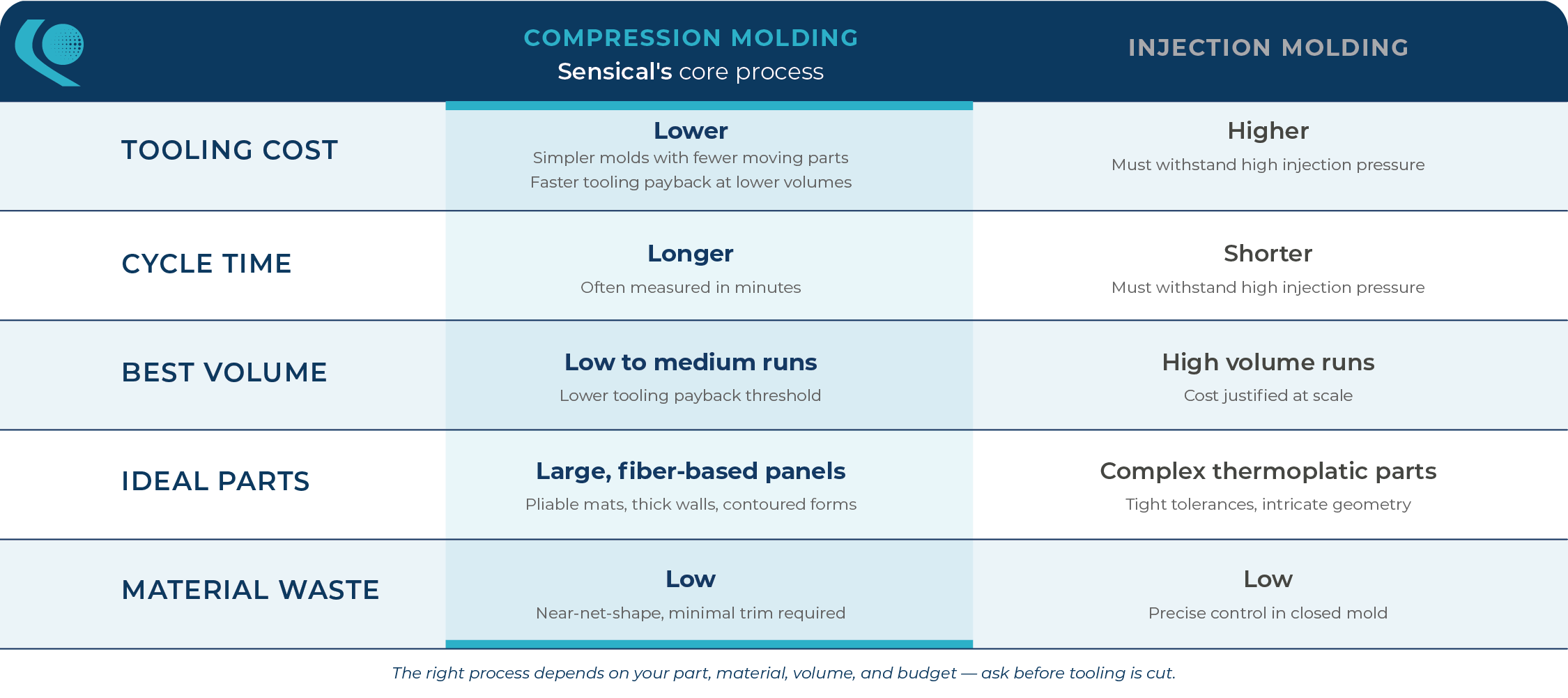
The point is not that one process beats the other. It is that the right choice depends on your part size, material, volume, and budget. A good molder will tell you which one fits before you commit to tooling, because the wrong call shows up later as scrap, weight, or cost you cannot design out.
In our experience, the parts that cause the most trouble are the ones locked into a process before anyone talks to a molder. The cheapest time to choose compression molding or injection molding is before the tool is cut.
Where Compression Molded Parts Show Up in a Vehicle
Most of the compression molded content in a vehicle works quietly, in both senses of the word. It manages noise, vibration, and harshness, the family of sounds and shakes that owners feel before they can name them.
Acoustic insulators are the clearest example. A dash insulator sits against the firewall and reduces the engine and road noise that reaches the cabin. These parts usually pair a dense barrier layer with a fibrous absorber, and the fiber mat is molded to the exact contour of the body panel so it seats correctly and performs.
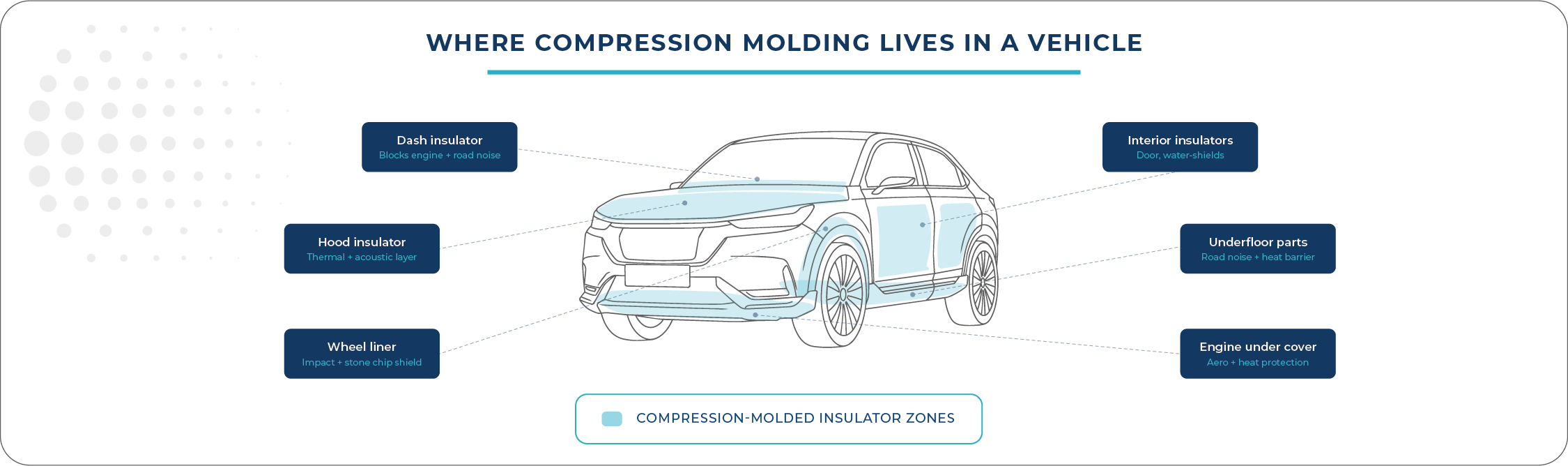
Compression molded parts you will find across a vehicle include:
- Dash and firewall insulators
- Hood insulators
- Tunnel insulators and underfloor parts
- Engine covers and engine under covers
- Aluminum heat shields and heat resistant pads
Fiber based absorbers such as nonwoven PET and cotton shoddy suit this work because they are light, they absorb sound across a useful range, and they hold a molded shape once compressed. Many of these parts begin upstream as flat material that is die cut and converted, then molded to final shape. That combination of low weight and formability is why so many automotive acoustic parts start as a fiber mat and end as a molded component.
Why Compression Molding Matters More Now
Two pressures are reshaping how OEMs think about these parts: weight and noise.
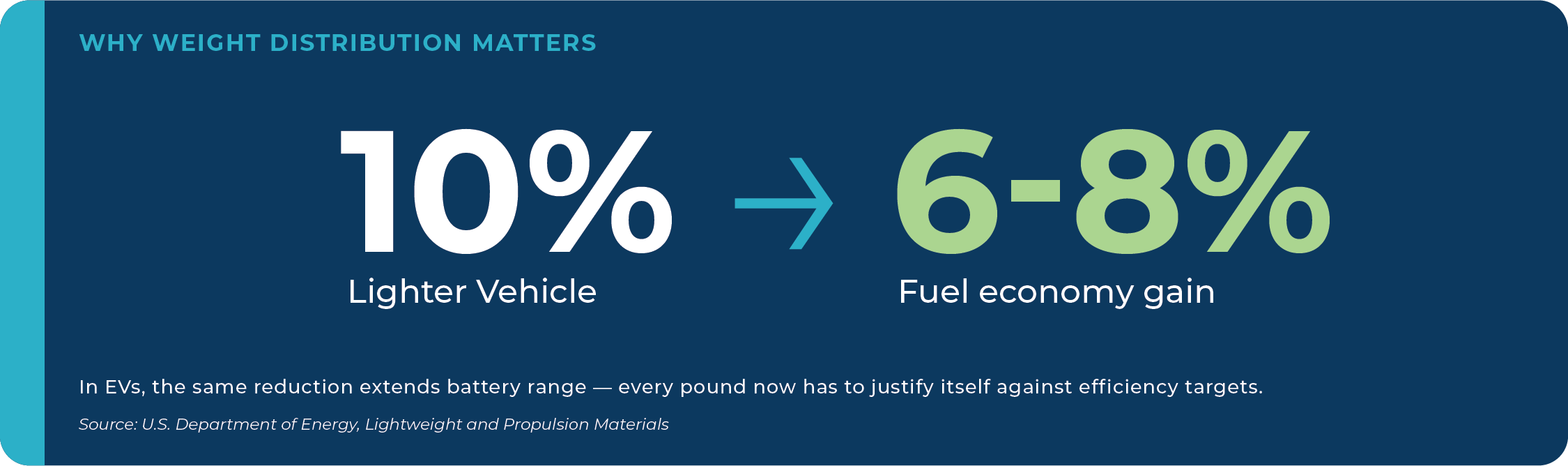
Weight is the measurable one. According to the U.S. Department of Energy, a 10 percent reduction in vehicle weight can yield a 6 to 8 percent fuel economy improvement, and in electric vehicles the same logic extends battery range. Heavy sound deadening used to be an easy answer. It is not anymore, because every pound now has to justify itself against efficiency and range targets.
Noise is the subtler one. As powertrains electrify, the engine noise that once masked road, wind, and motor sounds disappears, and those remaining sounds become far more noticeable inside the cabin. The industry response is a shift toward lightweight, high performing acoustic materials, which is exactly what compression molding produces. Molded fiber insulators deliver real acoustic performance at a fraction of the weight of older damping layers.
There is a durability and safety dimension too. Parts near the engine and underbody face heat and flammability requirements. Compression molded fiber and foam assemblies can be built for high heat acoustical applications and to meet V0 flammability requirements, which keeps them viable in the hottest zones of the vehicle.
How to Evaluate a Compression Molding Partner
Knowing the process is one thing. Finding a partner who runs it well is another. The questions below separate a molder who can run your tool from one who can help you get the part right.
What to confirm before you award the work:
- Press capacity and platen size for your largest part, at production volume, not prototype
- Tooling approach, including whether one step tooling can eliminate a post trim or waterjet operation
- Material experience with your specific substrate, whether fiberglass, PUR foam, or PET nonwoven
- In house converting, assembly, and finishing, so the part does not leave the building for a handoff you cannot audit
- Quality system and process control, with data on comparable parts
A molder that controls the work end to end, from material conversion through molding, trimming, and finishing under one roof, protects your lead time and your quality, because every handoff between vendors is a place for both to slip.
Sensical was built around that model. Operating from Solon, Ohio, the company runs custom engineered die cut and compression molded solutions using specialty materials and converting processes, with high tonnage presses, large platen capacity, and one step tooling that molds parts close to final shape. It is ISO 9001:2015 certified, produces more than 90 million components a year for over 180 customers, and has an average employee tenure of more than fourteen years, the kind of stability that shows up in the consistency of your parts.
How to Spec a Compression Molded Part
If you are bringing a new acoustic or thermal part to a molder, a short, repeatable sequence keeps the process from going sideways.
- Define the function first: acoustic absorption, heat shielding, sealing, or a combination, with target performance.
- Share the mating geometry, the panel or cavity the part has to seat against, so the tool matches the body.
- Set weight and packaging limits up front, since these often decide the material.
- Confirm the environment: temperature, flammability, and moisture exposure where the part lives.
- Agree on volume and timing, which drive the tooling and process choice.
- Run a sample and review full documentation before committing to production tooling.
Suppliers who work through this with you, rather than just quoting a print, are the ones worth a long term relationship.
Conclusion
Compression molding is not the flashiest process on the floor, but it is the right answer for a specific and growing class of automotive parts: large, lightweight, fiber based components that control noise and heat. As vehicles get lighter and quieter, those parts only get more important.
The molder worth building a relationship with is the one who helps you choose the right process, controls the work end to end, and is honest about what a part needs before the tool is cut.
If you have an acoustic, thermal, or other molded part you are evaluating, start with a capability conversation. The right partner will ask as many questions as you do.
Frequently Asked Questions
What is compression molding used for in automotive manufacturing?
It produces large, fiber based, and thick walled parts, most often acoustic and thermal insulators such as dash insulators, hood insulators, underfloor parts, and heat shields. These parts manage noise, vibration, and harshness while keeping weight down.
What is the difference between compression molding and injection molding?
Injection molding forces molten thermoplastic into a closed mold at high pressure, with fast cycles and high tooling cost, and it suits high volume, complex parts. Compression molding presses a charge in an open heated mold, with lower tooling cost and longer cycles, and it suits large panels, fiber materials, and low to medium volumes.
What materials can be compression molded?
Thermoset compounds, fiber reinforced mats, foams, and many thermoplastic compounds. For automotive acoustic and thermal parts, common substrates include fiberglass, PUR foam, and PET nonwoven fiber.
Is compression molding cost effective for low volume production?
Often yes. Its tooling costs less than injection tooling, so it is frequently the better economic choice at low to medium volumes, and it produces very little material waste.
Does Sensical offer compression molding in Ohio?
Yes. Sensical runs compression molding and vacuum forming along with converting, assembly, and finishing services from its facility in Solon, Ohio, serving OEMs across the automotive industry and beyond.