

A vehicle passes every durability test, then a trim squeak in the first owner surveys drags its quality scores down. An EV program removes the engine, and the road noise the engine used to mask becomes the loudest thing in the cabin. A sourcing team specs an insulator by thickness alone and learns at validation that thickness was never the variable that mattered.
All three problems belong to the same discipline. NVH insulation in automotive manufacturing is the family of materials and engineered parts that control what occupants hear and feel inside a vehicle, and it carries more weight in program outcomes than its line items suggest. Owners cannot see an insulator. They judge the vehicle by its absence or presence every time they close a door.
This guide explains what NVH means, how NVH insulation works, the materials OEMs specify, where buzz, squeak, and rattle fits in, and how to evaluate a manufacturing partner for acoustic parts. By the end, you will know what to put on the print and what to ask before the quote.
NVH insulation is the set of automotive components that reduce noise, vibration, and harshness inside a vehicle. The category covers fibrous absorbers, barrier layers, and damping materials, die cut or compression molded into parts such as dash insulators, hood insulators, tunnel insulators, underfloor parts, and engine under covers.
What Is NVH in Vehicles
NVH stands for noise, vibration, and harshness, the engineering discipline that measures and controls the sounds and sensations a vehicle transmits to its occupants. Each letter covers a different piece of the problem.
- Noise is airborne sound that reaches the cabin: road noise, wind noise, powertrain noise, and the hum of accessories.
- Vibration is energy felt rather than heard, transmitted through the seat, the steering wheel, the pedals, and the floor.
- Harshness is the subjective severity of both, the difference between a sound an owner tunes out and one that sends the vehicle back to the dealer.
Owners rank these problems high, and they keep ranking them high as vehicles age. In its 2026 China Vehicle Dependability Study, J.D. Power found that NVH problems become particularly pronounced as ownership lengthens, with tire noise, wind noise, and various rattles increasingly reported. The pattern holds across markets. In the firm’s 2023 Thailand Initial Quality Study, the two most reported problems across all new vehicles were excessive wind noise and excessive road noise, ahead of every mechanical and electronic category measured. Noise, vibration, and harshness is a direct input to the quality scores automotive brands compete on.
For the Tier 1 and Tier 2 suppliers who build the parts, NVH performance is a warranty cost and a scorecard line, and it shapes how owners judge the brand, one component at a time.
How NVH Insulation Controls Cabin Noise
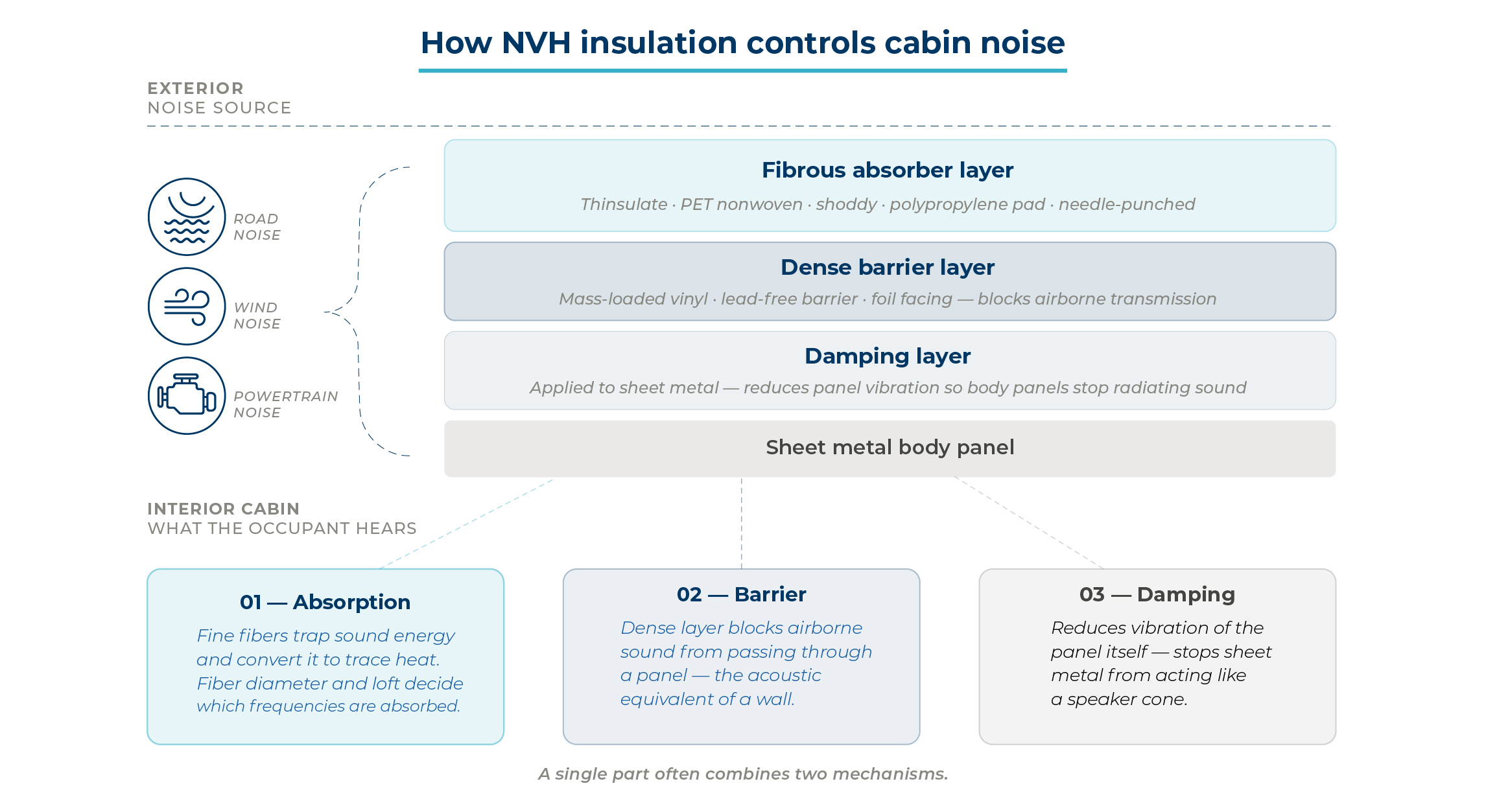
Noise reaches the cabin along two paths. Airborne noise travels as sound, passing through panels, seals, and air gaps. Structure borne noise travels as vibration through the body structure, then radiates from interior panels the way sound leaves a speaker. An effective acoustic package treats both paths, which is why NVH insulation works through three mechanisms, and why a single part often combines two of them.
- Absorption. Fibrous materials trap sound energy inside a web of fine fibers and convert it to trace amounts of heat. Fiber diameter and loft decide which frequencies the material absorbs.
- Barrier. Dense layers block airborne sound from passing through a panel, the acoustic equivalent of a wall. Barriers often pair with an absorber in a two layer construction.
- Damping. Applied layers reduce the vibration of the panel itself, so sheet metal stops acting like a speaker cone.
The absorber mechanism rewards fine fibers. 3M describes its Thinsulate acoustic insulation, a nonwoven absorber Sensical converts for automotive programs, as a combination of extremely fine polypropylene microfibers that absorb high frequency noise and thicker polyester fibers that provide recovery and loft, delivering high energy absorption at low weight. That tradeoff, acoustic performance per gram, is the axis the whole category competes on.
NVH insulation shows up across the vehicle:
- Dash and firewall insulators between the engine bay and the cabin
- Hood insulators that absorb engine noise at the source
- Tunnel insulators and underfloor parts along the driveline path
- Engine under covers and underbody insulation against road noise
- Interior insulators behind trim, carpet, and pillars
Many of these parts start as flat fiber material and end as a formed, three dimensional component. The fiber mat is compression molded to the exact contour of the body panel it seats against, because an insulator that does not seat correctly leaves gaps that leak sound. After molding, the part reaches final shape either through one step tooling that trims in the tool itself, or through robotic waterjet cutting, which follows the three dimensional contour without adding heat to the finished acoustic layers. Form and function are the same problem in this category.
NVH Insulation Materials OEMs Specify
The material set divides into fibrous absorbers, which do the acoustic work, and the molded substrates and films that give parts their structure and durability. The right answer depends on the frequency content of the noise, the temperature of the location, the flammability requirement, and the mass budget.
Fibrous absorbers in production use include:
- Thinsulate, the fine fiber nonwoven built for absorption per unit weight
- Shoddy and shoddy with scrim, recycled fiber blends molded to hold a contour
- PET nonwoven fiber, a workhorse for molded sound absorbing insulators
- Polypropylene pad and blown padding for cavity filling
- Needle punched, thermal sealed, and cotton blend constructions
For compression molded NVH applications, the substrate set runs to glassfiber, PUR foam, and PET nonwoven, molded for weight reduction with V0 flammability built in from the material up, which keeps parts viable in the hottest zones of the vehicle. Sensical converts and molds this full range through its acoustical NVH insulator line, serving the hood, dash, tunnel, underfloor, and engine under cover applications listed above. When procurement teams compare NVH insulation materials, OEM programs usually come down to the same three questions: does the material absorb in the right frequency band, does it survive the location, and what does it weigh.
An insulator is specified by what it absorbs, where it lives, and what it weighs. Thickness is an output of those three decisions, never the starting point.
BSR: The Other Half of the Noise Problem
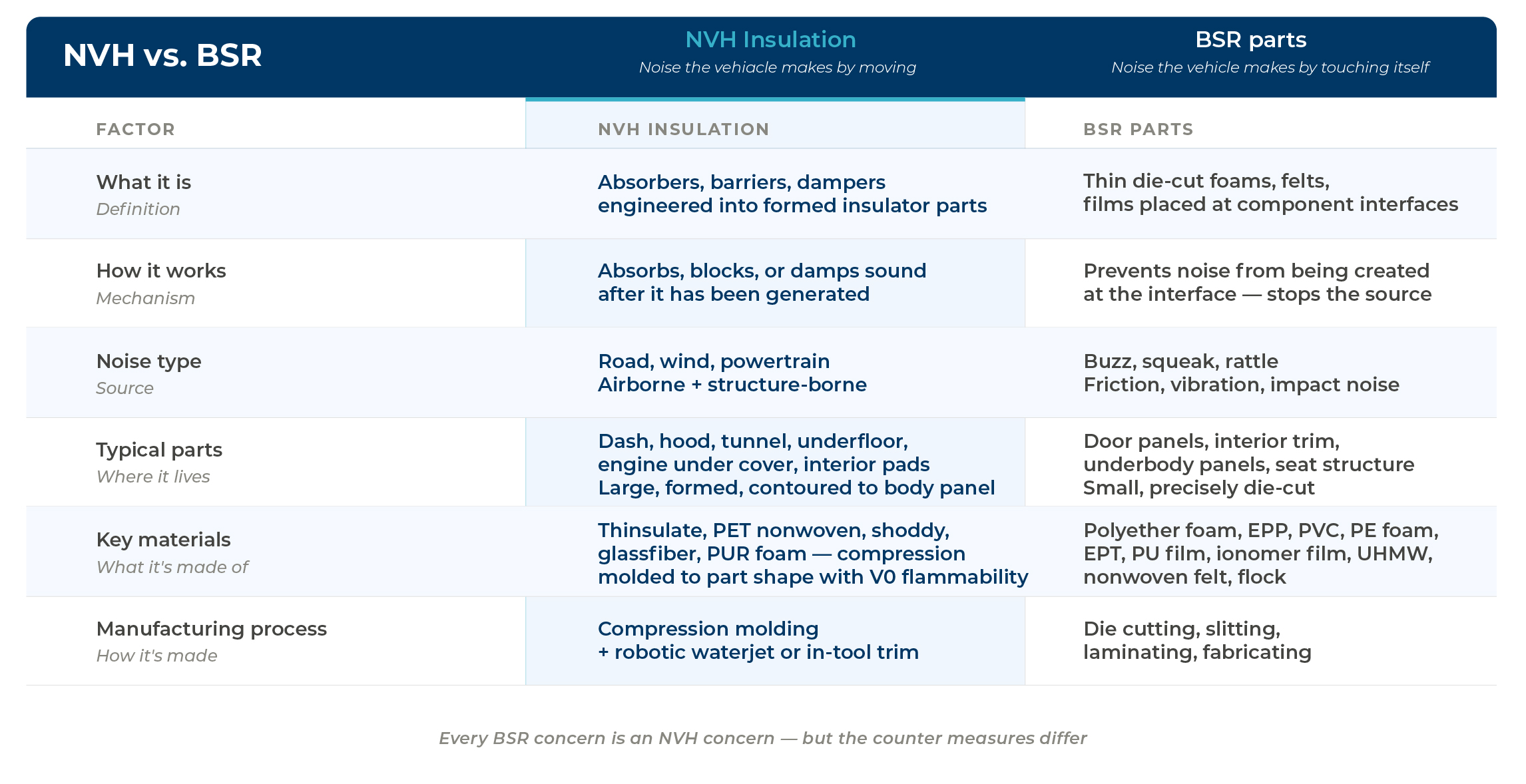
Insulation controls the noise a vehicle generates by moving. Buzz, squeak, and rattle, abbreviated BSR, covers the noise a vehicle generates by touching itself.
- Buzz is a short, higher frequency sound triggered by vibration exciting a component.
- Squeak is friction noise, produced when two parts rub in stick slip motion.
- Rattle is impact noise between loose or inadequately constrained components.
Every BSR concern is an NVH concern, but the countermeasures differ. Insulators absorb and block sound. BSR parts prevent sound from being created at all, by separating, cushioning, or isolating the surfaces that would otherwise touch. In BSR automotive manufacturing, that work falls to thin, precisely die cut parts: polyether foams, nonwoven felts, EPP, PVC, EPT, and PE foams, polyurethane film, ionomer film, UHMW film, and flock, placed at the exact interface where two components meet.
The stakes show up in the same dependability data cited above. Rattles sit among the problems owners report more as vehicles age, which puts BSR automotive manufacturing inside the quality conversation for the full ownership period, long after the launch audit closes.
The parts are small and the engineering is not. Solving a squeak means understanding the physics, structural dynamics, and material science of the interface, then producing a part that holds its position and its properties for the life of the vehicle. Sensical’s buzz, squeak, and rattle line pairs that engineering support with die cut, slit, laminated, and fabricated BSR parts across interiors, doors, and underbody panels.
Why NVH Matters More Now
Two industry shifts are raising the stakes on acoustic parts at the same time.
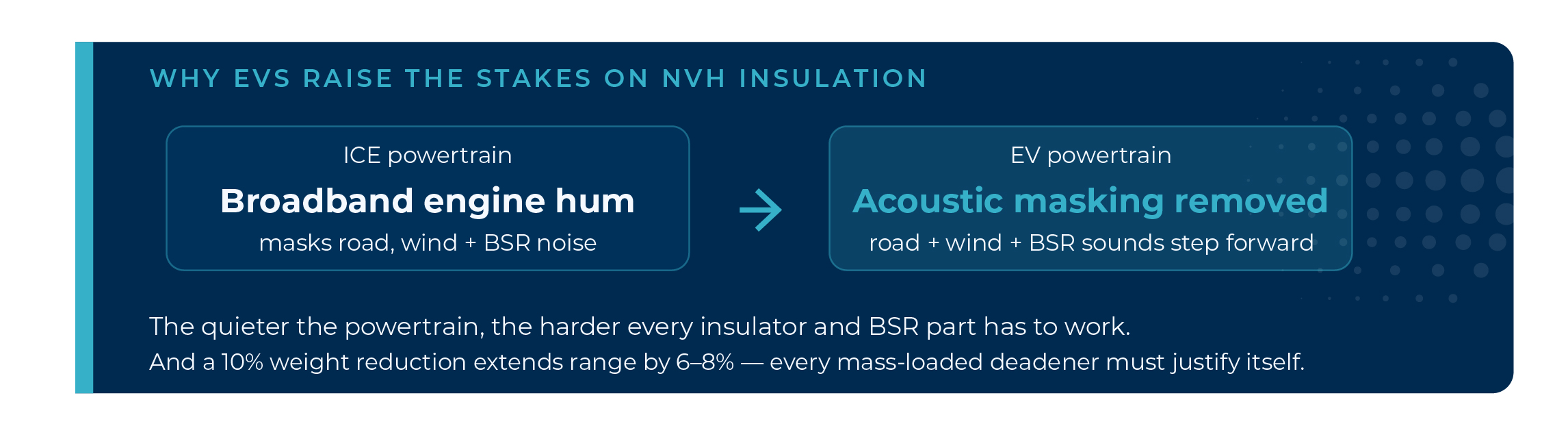
The first is electrification. An internal combustion engine produces a broadband hum that masks road noise, wind noise, and small interior sounds. Remove the engine and the masking disappears. Road and wind noise step forward, and the squeaks and rattles that an engine covered become audible for the first time. The quieter the powertrain, the harder every insulator and BSR part in the vehicle has to work.
The second is mass. According to the U.S. Department of Energy, a 10 percent reduction in vehicle weight can yield a 6 to 8 percent fuel economy improvement, and in electric vehicles the same reduction extends range. Heavy mass loaded sound deadening was once the easy answer to a noise problem. Every pound of it now has to justify itself against an efficiency target, which is why the category keeps moving toward lightweight fiber absorbers that deliver acoustic performance without the mass penalty.
The result is a tighter specification than the category has ever carried. Parts must absorb more, weigh less, meet V0 flammability in hot zones, and hold their molded shape through years of thermal cycling. Material selection and process control decide whether a part meets that specification, which is why the manufacturing partner matters as much as the print.
How to Evaluate an NVH Insulation Partner
Acoustic parts punish handoffs. A fiber mat that one vendor converts, a second vendor molds, and a third vendor trims arrives at your dock with three chances for variation built in. The evaluation below separates a supplier who sells material from a partner who controls the acoustic part end to end.
What to confirm before you award the work:
- Material breadth. Access to the full absorber and substrate range, from Thinsulate and shoddy to glassfiber, PUR foam, and PET nonwoven, so the material fits the problem instead of the inventory.
- Converting and molding under one roof. Die cutting, compression molding, waterjet trimming, and lamination in one facility, so the part never leaves the building between processes.
- BSR capability alongside insulation. A partner who handles both halves of the noise problem can solve at the interface or at the panel, whichever the physics favors.
- Flammability and environment experience. Proven V0 constructions and high heat acoustical applications for engine bay and underbody locations.
- Quality system and workforce stability. ISO 9001 certification as the floor, with process data on comparable parts and the kind of workforce tenure that keeps molded part consistency from drifting.
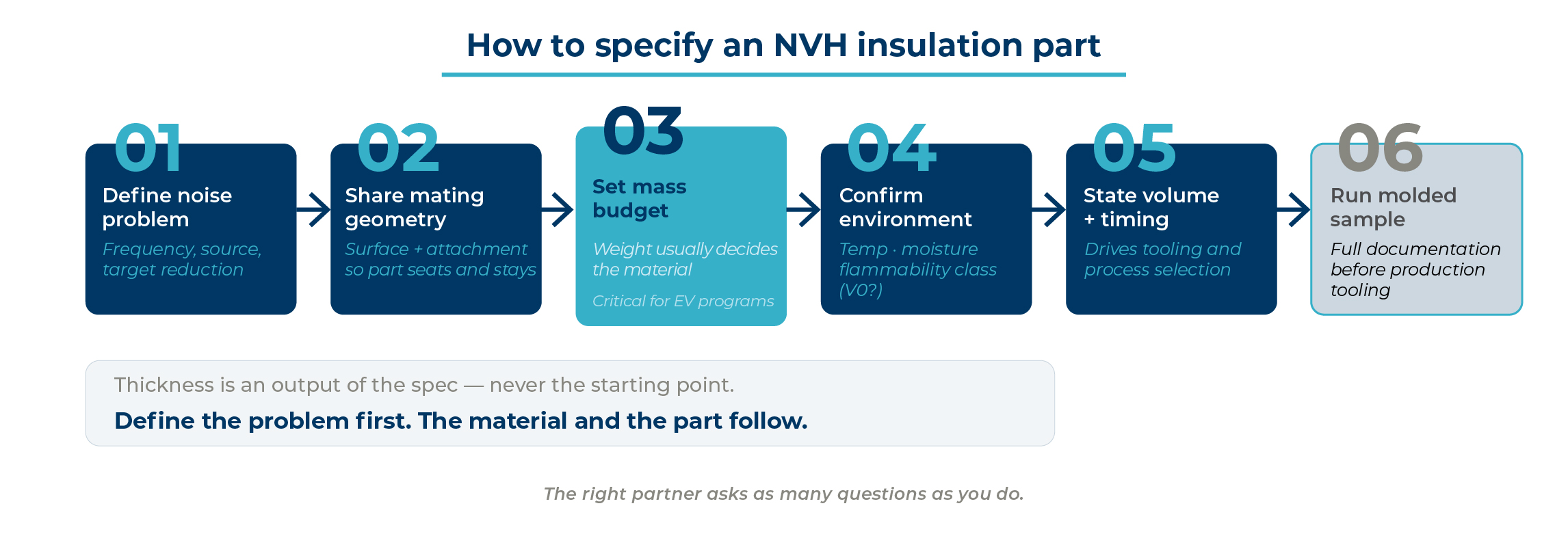
A practical sequence for specifying an NVH part:
- Define the noise problem first: the frequency content, the source, and the target reduction, not just a material callout.
- Share the mating geometry and the attachment method, so the molded part seats and stays seated.
- Set the mass budget and packaging space up front, since these usually decide the material.
- Confirm the environment: temperature, moisture, and flammability class where the part lives.
- State volume and timing, which drive the tooling and process choice.
- Run a molded sample with full documentation before committing to production tooling.
Sensical has built automotive NVH insulation and BSR solutions from its facility in Solon, Ohio since 1978, converting, molding, trimming, and assembling acoustic parts under one roof and one ISO 9001:2015 certified quality system. The operation produces more than 90 million components a year for over 180 customers and holds an average employee tenure of more than fourteen years, the kind of stability that shows up in the consistency of your parts.
Conclusion
NVH insulation in automotive manufacturing decides what a vehicle sounds like to the person who owns it, and owners grade the result in every quality survey. The discipline spans fibrous absorbers, barriers, and dampers for the noise a vehicle makes by moving, and die cut BSR parts for the noise it makes by touching itself. Electrification and mass targets are tightening both specifications at once.
The partner worth a long term relationship understands the physics, carries the material range, and controls converting, molding, and trimming in one building, because acoustic performance is built into a part at every process step and lost at every handoff.
If you have an acoustic or BSR part you are sourcing, start with a capability conversation. The right partner will ask as many questions as you do.
Frequently Asked Questions
What is NVH in vehicles?
NVH stands for noise, vibration, and harshness. Noise is airborne sound reaching the cabin, vibration is energy felt through contact points such as the seat and steering wheel, and harshness is the subjective severity of both. NVH engineering measures and controls all three to shape what occupants hear and feel.
What is NVH insulation in automotive manufacturing?
NVH insulation automotive programs specify includes the absorbers, barriers, and damping materials built into parts such as dash insulators, hood insulators, tunnel insulators, underfloor parts, and engine under covers. These components absorb or block the road, wind, and powertrain noise that would otherwise reach the cabin.
What materials are used for automotive NVH insulation?
Common fibrous absorbers include Thinsulate, shoddy and shoddy with scrim, PET nonwoven, polypropylene pad, needle punched, thermal sealed, and cotton blend constructions. Compression molded NVH parts use substrates including glassfiber, PUR foam, and PET nonwoven, available in constructions that meet V0 flammability requirements.
What is BSR in automotive manufacturing?
BSR stands for buzz, squeak, and rattle: the intermittent noises created when vehicle components vibrate, rub, or impact each other. BSR parts are thin, die cut foams, felts, and films placed at component interfaces to prevent the noise from being created. Every BSR concern is an NVH concern, but BSR countermeasures work at the interface rather than at the panel.
Does Sensical manufacture NVH insulation in Ohio?
Yes. Sensical manufactures acoustical NVH insulators and BSR solutions from its ISO 9001:2015 certified facility in Solon, Ohio, converting, compression molding, and trimming acoustic parts for hood, dash, tunnel, underfloor, and engine under cover applications across automotive programs.